TurboStarter Review: Three Platforms From One Repo for $249
Updated on August 30, 2026
TurboStarter ships web, mobile, and a browser extension from a single monorepo, with auth, billing, and multi-tenancy already wired. Here is what that buys you, what it costs you, and who should skip it.
Verdict
The widest scope I have seen in a boilerplate at this price, documented in public so you can check it, and resting entirely on one person.
- Best for
- TypeScript developers shipping a subscription SaaS who also want the mobile app or the extension, and do not want to maintain three codebases to get them.
- Skip it if
- You are not building something SaaS shaped, you would rather learn the stack by building it, you only need web, or $249 is most of your budget.
- Price
- $249 one-time
What works
- One monorepo covers web (Next.js), mobile (Expo), and a browser extension (WXT), which almost nothing else at this price does
- The full documentation is public before you pay, so you can audit the architecture instead of trusting a feature list
- Providers are swappable by design: four billing providers, six email services, three databases, six deployment targets
- Ships the AI agent scaffolding (CLAUDE.md, AGENTS.md, an MCP server, a CLI) instead of leaving you to write repo rules yourself
- One payment, lifetime updates, unlimited projects, so the second thing you build with it costs nothing
What does not
- One maintainer. Every update, security fix, and framework migration depends on Bart staying interested
- You can read the docs about the code before buying, but not the code
- The AI Kit, which is what the 'AI-first' pitch mostly leans on, sits behind the $399 bundle
- Free starters get you a surprisingly long way for $0, and the gap is narrower than the price suggests
- Updates arrive as a git merge from upstream, and the docs have a conflict-resolution section for a reason
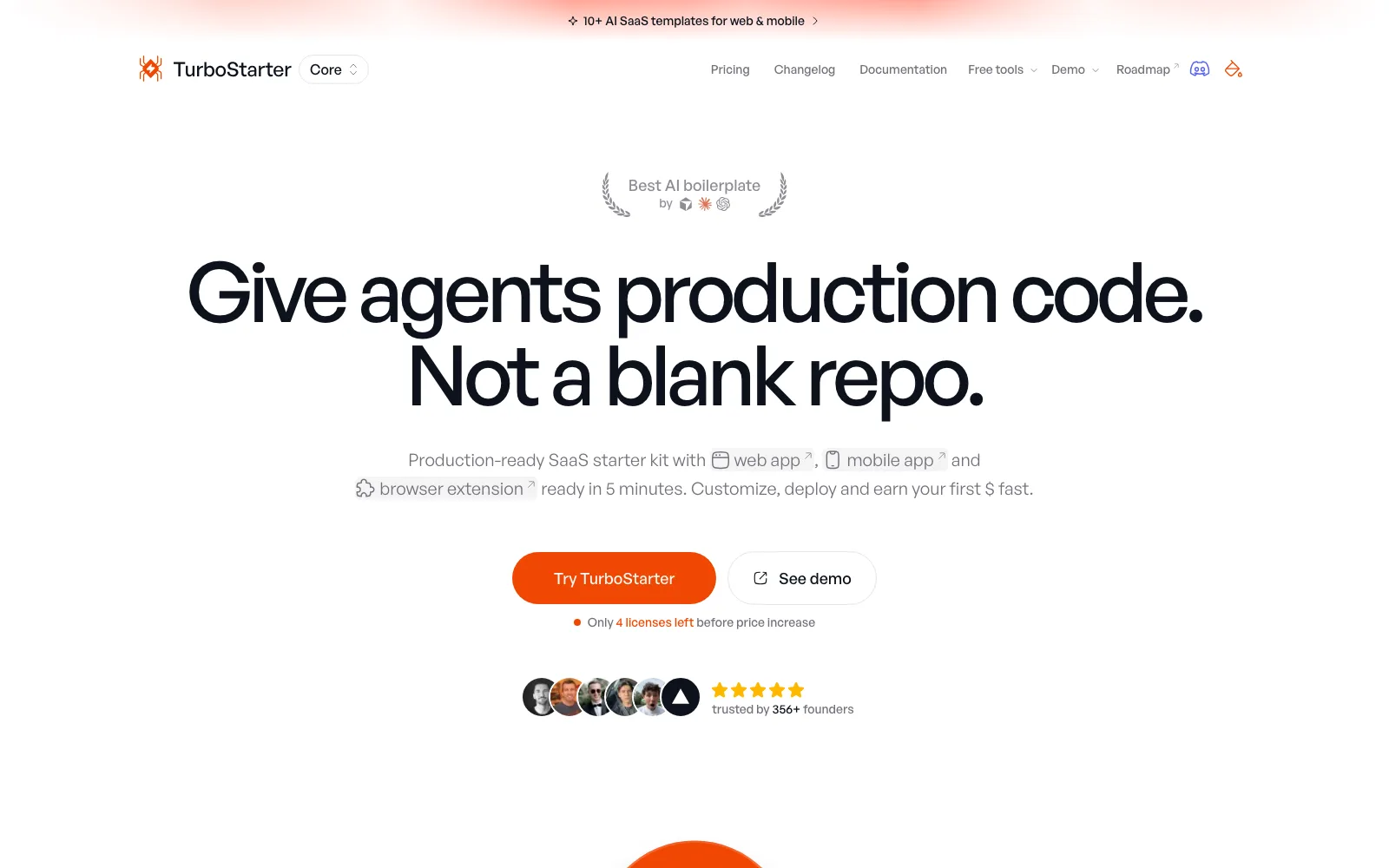
- The homepage runs an 'only 4 licenses left' counter on a product that is a git repository
People ask me every few months whether a paid SaaS boilerplate is worth it, and my answer is usually a shrug. TurboStarter is the first one where the answer gets more specific, because it is not selling a faster Next.js app. It is selling three apps.
Disclosure before anything else. This review is part of a partnership with TurboStarter, and the product links in it are affiliate links, which means Nick Launches earns a commission if you buy through them. That arrangement bought a review, not a verdict. Nobody there saw a word of this before it went live, the "where it falls short" section is the longest on the page, and the "skip if" list was written before the pros were.
A note on method. I did not buy a license, so I have not run the code. That matters less than usual here, because TurboStarter publishes its whole documentation set in the open at turbostarter.dev/docs, down to file paths, config schemas, and migration commands. Most boilerplates hide the docs behind the paywall with the code. Everything below comes from those docs and their public pages, checked on 30 August 2026.
What TurboStarter actually is
A Turborepo monorepo that ships three applications sharing one set of packages.
- Web is Next.js on the front, Hono on the API side, with React Query, Better Auth, Drizzle, and Tailwind.
- Mobile is React Native through Expo.
- Extension is WXT, the Vite-based framework for browser extensions.
Auth, database schema, billing logic, i18n strings, and design tokens live in shared workspace packages. Add a field to the user table once and all three surfaces know about it.
That is a different pitch from the rest of this market. ShipFast, Achromatic, and most of the $99 to $199 tier are Next.js and only Next.js. Paying $249 to skip auth on a web app is a hard sell. Paying it to skip auth on a web app, an iOS app, and a Chrome extension that share one session model is an easier one.
The monorepo is the real product
Anyone can wire Stripe into Next.js in a weekend. What eats months is keeping billing state consistent across a web dashboard, a mobile app billed through RevenueCat, and an extension that has to read entitlements from somewhere.
TurboStarter's answer is that all three read from the same @workspace packages, and the billing config is one shared schema mapping plan variants to provider price IDs. Swap Stripe for Polar and the mobile app does not care. The billing docs cover subscriptions, one-time payments, credit ledgers, metered usage, and per-seat pricing that auto-counts organization members at checkout, across Stripe, Lemon Squeezy, Polar, and Dodo Payments.
Multi-tenancy is built the same way: organizations, memberships, and invitations joined on organizationId, with roles enforced through the Better Auth organization plugin on both client and server. If you have ever retrofitted teams onto a single-user app, you know that is the expensive kind of decision to get wrong late.
The swappability is the part I would pay for. Three databases, six email providers, six analytics platforms, four job runners, six deployment targets. Not because you will use them all, but because the code is written against interfaces rather than against Stripe specifically. That is the difference between a starter you grow out of and one you have to escape.
What you get
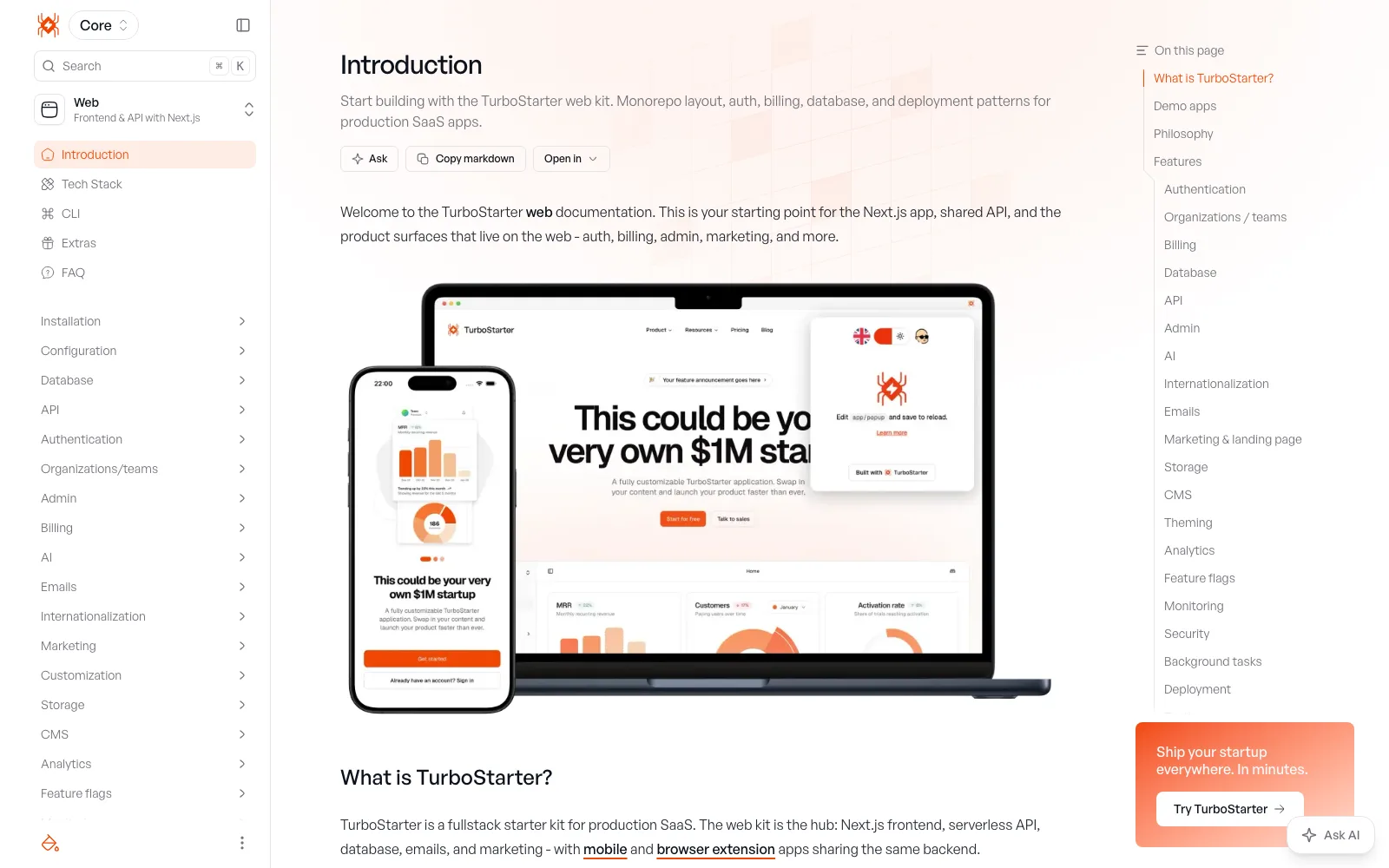
Auth. Email and password, magic links, OTP, passkeys via WebAuthn, Google One Tap, OAuth for Google, GitHub, and Apple, plus TOTP two-factor with backup codes. Built on Better Auth.
Billing. Covered above. Four providers on web, plus RevenueCat and Superwall on mobile.
Teams and admin. Invitations with signed expiring tokens, RBAC, and a super admin dashboard you can extend with your own role checks.
Marketing. Home, waitlist, newsletter, blog, pricing, contact, and legal pages, with an MDX CMS through Content Collections. Feature flags run on OpenFeature.
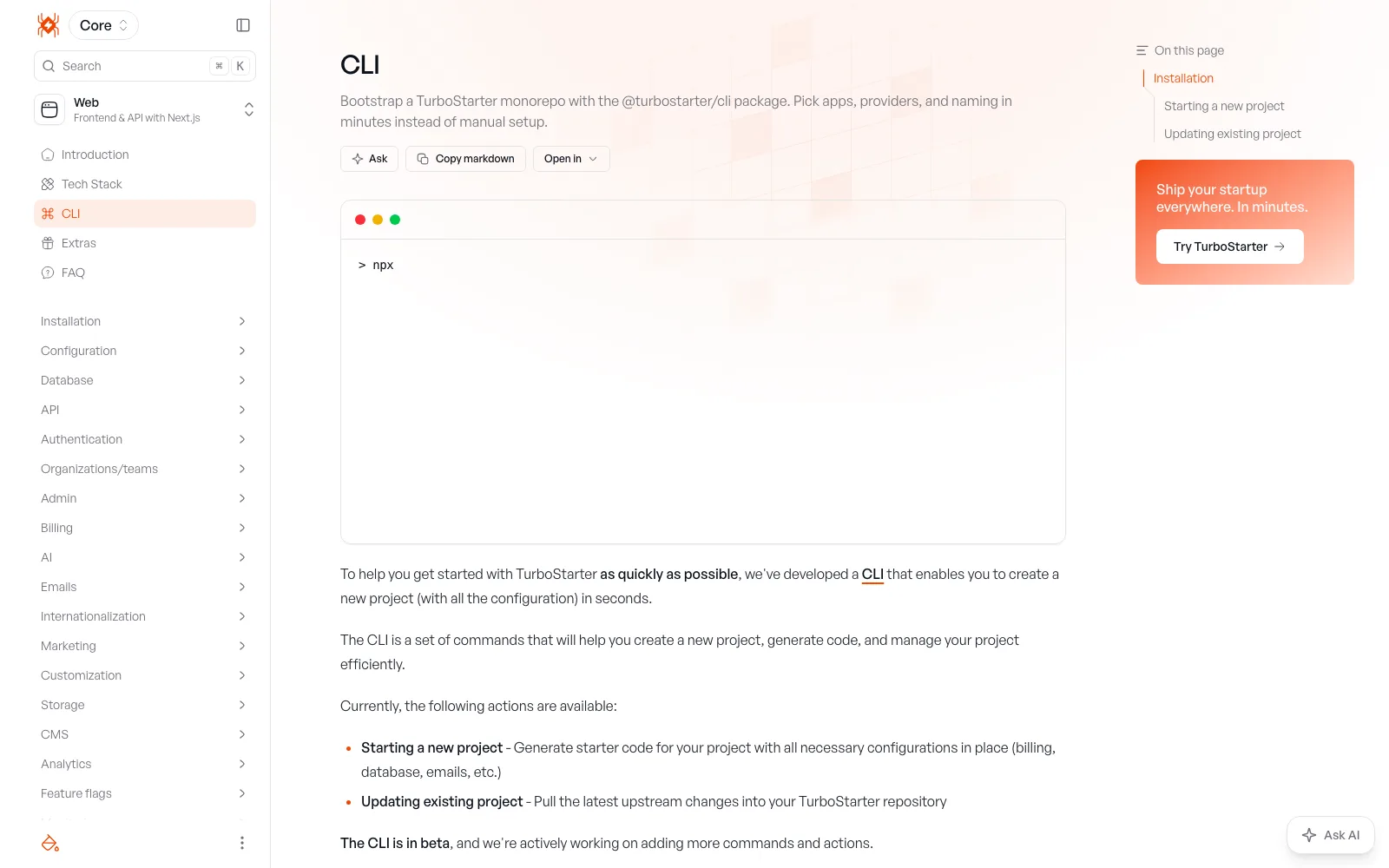
The AI tooling. Worth being precise about what "AI-first" means here. Not that the app has AI features. That the repo is set up to be worked on by coding agents: dedicated CLAUDE.md and AGENTS.md files, editor rules and skills, and an MCP server giving Cursor or Claude Code structured access to the codebase. A CLI scaffolds a project with your provider choices selected and pulls upstream updates later. It is marked beta in their own docs.
Extras. A private Discord, 25+ pre-written SaaS ideas, a showcase page, and lifetime updates.
What the first hour looks like
I have not run it, so this is the documented path rather than a stopwatch reading.
You run npx @turbostarter/cli@latest and answer questions about which apps and providers you want. You get a monorepo with upstream already set as a git remote, which is how updates arrive later. Then pnpm i, fill in a root .env and apps/web/.env.local for secrets, run Drizzle migrations with db:generate and db:migrate, and start the dev server.
Realistically the first hour is not spent on code. It goes on a Postgres instance, a Stripe account with products and webhooks, an OAuth app or two, and a Resend domain. That work exists whether or not you buy a boilerplate. What you skip is the glue between all of it, which is what takes the following two weeks.
Pricing
Two options, both one-time payments with a lifetime license and unlimited projects.
| Plan | Price | List price | What it adds |
|---|---|---|---|
| Core Kit | $249 | $349 | Web, mobile, and extension kits, auth, billing, teams, admin, i18n, MCP, CLI, Discord, lifetime updates |
| Bundle All-in-One | $399 | $499 | Everything above plus the AI Kit: 10+ AI templates, multiple providers, tool calling, memory, credit gating |
The AI Kit sells separately at $249, so the bundle prices it at $150 as an add-on. Worth it if you are building an AI product, irrelevant if you are not. Note the oddity that the kit doing the most work in the phrase "AI-first" is the one the entry tier does not include.
The strikethrough prices deserve a mention. $349 and $499 are presented as the real prices, and I cannot verify anyone has paid them. There is also a counter on the homepage reading "only 4 licenses left before price increase," which, on a product that is a git repository, is a marketing device rather than an inventory fact. It does not make the code worse. It did make me trust the rest of the page a little less, and I would rather say so than pretend I did not notice.
Current pricing is on their site. Given the countdown, treat any number here as a snapshot.
Who this is actually for
The narrow version of the buyer is convincing. The broad one is not.
It fits the developer who already writes TypeScript and React daily, is building a subscription product with accounts and teams, and knows a mobile app or an extension is on the roadmap rather than a maybe. For that person, $249 is a couple of hours of billable time against several weeks of undifferentiated plumbing, and the shared cross-platform state is worth more than the auth screens.
It also fits agencies and repeat builders, since the license covers unlimited projects. The second product you ship with it is free.
It does not fit someone learning. Handing yourself an architecture you did not choose is a bad way to understand Next.js, and you will spend the saved time reading someone else's conventions instead. It also does not fit a product that is not shaped like a SaaS. A marketing site, an internal tool, a marketplace with unusual payment flows: the org and subscription assumptions baked in here will fight you.
Where it falls short
One person. Bart Zagrodzki builds and maintains this alone. The docs are thorough and he is public about being the person behind it, which is more than some competitors manage. But you are buying a dependency with a bus factor of one, and the whole value of "lifetime updates" is a bet on his continued interest through the next React Native migration and the next Next.js major. Price that in.
You cannot read the code first. The docs are open, which is unusually good. The repository is not. You are making a $249 judgment on documentation quality as a proxy for code quality, and those correlate without being the same thing.
Breadth against depth. Three platforms, four billing providers, six email services, six deployment targets, one maintainer. A web-only kit built by a team will probably have better-tested Stripe edge cases than a three-platform kit built solo. Whether that matters depends on whether you ship the mobile app or just liked knowing you could.
Updates are a merge. Their update guide is git stash, pull from upstream, resolve conflicts, run lint and typecheck. That is the normal and honest way to do this, and it is also what everyone underestimates. Six months of your changes against six months of upstream changes is a real afternoon, forever. Boilerplates do not have upgrade paths. They have merge conflicts.
Architecture lock-in. You are adopting Hono for the API, Drizzle for the ORM, Better Auth for sessions, Base UI for components. All reasonable 2026 choices. None of them yours. If your team has different opinions, you are either fighting the starter or throwing away the parts you paid for.
Free is a real competitor. create-t3-app and the official Next.js SaaS starter cost nothing and cover a meaningful slice of this. What you are really buying is the mobile app, the extension, the multi-tenancy, and the billing depth. If you do not need those four, the honest comparison is $249 against $0 and a longer weekend.
Alternatives worth a look
- create-t3-app. Free, community-maintained, typed end to end. No billing, no teams, no mobile. The right start if you want to understand what you built.
- The official Next.js SaaS starter. Free, from Vercel, Postgres and Stripe wired up. Thin next to any paid kit, and it will never be abandoned.
- ShipFast. The one that made this category. Web-only, tuned for shipping in a weekend, large community. Less architecture, more momentum.
- Makerkit. Paid, B2B-focused, strong multi-tenancy, a team behind it rather than one person. Compare it directly if the org model is your reason to buy.
- supastarter. Multi-framework, Supabase-flavored, similar breadth ambitions. The closest competitor on scope.
- ixartz SaaS Boilerplate. MIT-licensed, free, multi-tenancy included. Worth an hour before you spend $249.
TurboStarter runs its own comparison page against most of these. It is their page, so read it as such, but it names competitors with prices attached rather than strawmen, which is a point in its favor.
FAQ
Is TurboStarter a subscription? No. One-time payment for a lifetime license, currently $249 for the Core Kit and $399 for the bundle, with lifetime updates included.
Can I use it for more than one project? Yes, the license covers unlimited projects. That is the main reason the price works for agencies and repeat builders.
What is actually "AI-first" about it? Two things. The codebase ships agent scaffolding (CLAUDE.md, AGENTS.md, editor rules, an MCP server) so tools like Cursor and Claude Code can work in it with context. The AI Kit, which adds provider integrations, tool calling, memory, and credit-based access, is a separate product bundled only in the $399 tier.
Do I need the mobile and extension apps? No, the CLI lets you pick which apps to include. But if you only ever want web, you are paying for scope you will not use, and a web-only kit or a free starter is the fairer comparison.
Who maintains it? Bart Zagrodzki, working solo, with a private Discord for support. That is both why the docs are this coherent and the main risk in the purchase.
Should you use it?
If you are shipping a real subscription SaaS in TypeScript, teams and billing are in scope, and there is any chance of a mobile app or an extension, buy it. The cross-platform shared state is hard to get anywhere else near this price, the docs work as a free evaluation first, and the unlimited-projects license amortizes fast if you ship more than once.
If you are still deciding what you are building, spend a weekend with create-t3-app instead. You will learn more and lose nothing.
The 4 out of 5 is for scope and documentation. The missing point is not about the code, which I could not read. It is that a $249 purchase resting on one maintainer deserves a page that sells on substance, and this one runs a scarcity counter it does not need. The product is stronger than the marketing around it, which is an unusual problem to have and an easy one to fix.
Building something? Submit it on Nick Launches. Listing is free and the do-follow backlink is permanent. If you are working out where else to get listed, start with the launch directories list and the basic SEO guide.