Most launch posts are read once. A free tool gets used, saved and sent to a friend, and it is the kind of page other sites link to when they write about your topic. The cheapest free tool to build is a calculator: a few inputs your buyer already knows, one honest formula, and an answer about their own situation.
The AI Break published a pattern for this on October 27, 2026: seven chained prompts in one Claude Code project, brief, pick, spec, build, test, capture and launch. Their full prompts are in a paid post. I followed the stages on Nick Launches with prompts of my own, and the result is live: the Launch Week Calculator. Pick the directories you plan to launch on and it shows the referral visits and dofollow links to expect. Everything below is from that build on November 2, 2026.
Write the brief and the calculator rules
Make an empty folder, put a CLAUDE.md in it, and start Claude Code there. The brief is facts, not marketing: what you sell, to whom, the paid offer, the brand. Every later prompt reads it, so you write it once.
The part that matters is the rules. A calculator that makes up an "industry average" is a lead magnet that lies, and visitors who check one number stop trusting all of them. The AI Break's rules come down to four ideas, and mine say the same thing in my words:
# Project brief

Business: Nick Launches, a weekly launch board. Builders list a product
for free and get a permanent listing page with a dofollow link. Paid
plans pin the product in a Featured section for 7, 14 or 30 days.
Buyer: indie builders and small teams in their first launch week.
Paid offer: Featured placement, and a done-for-you submission service.
Brand: orange on black and white, DM Sans. Voice: plain, direct, honest.

## Calculator rules
- Every number on the page is typed by the visitor or is a labelled
  assumption shown on the page and editable.
- Never invent industry averages, benchmarks or statistics. Assumptions
  come from data the owner gives you, with its source and date.
- The visitor's numbers never leave the browser.
- One file: site/index.html with HTML, CSS and JavaScript together.
  No framework, no build step.
A rule in a prompt is followed for one answer. A rule in CLAUDE.md is read before every step, including the build three prompts later, when the temptation to fill a blank field with a plausible number is highest.
Let Claude pick, then argue with it
Give Claude real questions your buyers ask and have it propose calculators of four types: Cost (what will this cost me), Loss (what is this costing me now), Return (what do I get back) and Readiness (am I ready). Each idea gets a 1 to 5 score on urgency, easy inputs, surprising result and fit with your paid offer. I gave it six questions builders asked me this month, from "How many directories should I submit to?" to "Is a paid featured spot worth it?".
I came in with my own idea, so after the first round I asked Claude to score it on the same scale without changing the others. Here is the table, as Claude Code returned it:
| # | Idea | Type | Headline result | Urgency | Easy inputs | Surprise | Fit | /20 |
|---|---|---|---|---|---|---|---|---|
| 1 | Spike-and-Drop | Loss | Your traffic is down X% since launch day, worth $Z a month | 5 | 4 | 5 | 4 | 18 |
| 2 | DIY Submission Hours | Cost | N directories take X hours of your launch week | 4 | 5 | 3 | 5 | 17 |
| 3 | Featured Break-even | Return | A featured spot pays for itself at N extra visitors | 3 | 4 | 4 | 5 | 16 |
| 4 | Your Hour vs Our Hour | Return | Doing it yourself costs $X in time | 3 | 5 | 3 | 5 | 16 |
| 5 | Launch Week Directory (mine) | Return | N referral visits and M dofollow links, K from stronger sites | 4 | 2 | 4 | 4 | 14 |
| 6 | Launch Kit Readiness | Readiness | You are X of 6 ready; fix these first | 3 | 5 | 2 | 3 | 13 |
Claude recommended Spike-and-Drop and ranked mine fifth. Its reason was fair: "expected upvotes per directory and your own DR are guesses or lookups." I built mine anyway, for one reason the scores do not capture: Spike-and-Drop needs numbers from after a launch, and the builder deciding where to launch has none yet. A lead magnet has to work for the person who has not started.
But I took the criticism. Domain Rating and link type now come preloaded from our directory catalog, and expected upvotes default to a measured number, so a visitor can get a result without typing anything and then change what they know.
If a visitor has to open another tab to answer a field, most of them will not come back. Every input should be something they know, or a default you can defend with a source.
Write the math down before any code
Before any code, Claude writes a spec.md: every input with a default, a minimum and a maximum, every assumption with its source, the formula in plain English, and three worked examples you can check on a phone. This is the step that catches a wrong formula, because you read it in words.
I gave it real data for the defaults. Nick Launches records clicks on the "Visit website" button on each listing page, so I counted them for every launch from October 5 to 25, 2026, over each launch's first seven days:
The inputs, as specified:
| Input | Default | Range |
|---|---|---|
| Directories, one row each | 8 launch boards from the catalog | 1 row or more |
| Row: Domain Rating | From the catalog | 0 to 100 |
| Row: link type | From the catalog | dofollow or nofollow |
| Row: expected upvotes | 10 (assumption A4) | 0 to 10,000 |
| Row: featured spot paid | No | yes or no |
| Your site's Domain Rating | Blank | 0 to 100, optional |
The assumptions, each shown on the page with its source and editable:
| Assumption | Default | Source | |
|---|---|---|---|
| A1 | Visits per upvote, free listing, first 7 days | 0.149 | Nick Launches, launches from October 5 to 25, 2026: 377 clicks on 2,536 upvotes, 237 launches |
| A2 | Visits per upvote, featured listing, first 7 days | 0.321 | Same window: 182 clicks on 567 upvotes, 32 launches |
| A3 | Share of submissions approved | 100% | No measured source, labelled as such |
| A4 | Upvotes on a new row | 10 | Median free launch on Nick Launches, same window |
The formula, per row, then added up:
- Visits = upvotes × visits per upvote (A2 if featured, A1 if not) × share approved (A3).
- A dofollow row adds A3 links. A nofollow row adds none to the dofollow count.
- A link is "stronger than yours" when it is dofollow and the directory's DR is higher than your site's. Hidden if you leave your DR blank.
And the three worked examples, which became the tests in step 5:
- One directory, DR 55, dofollow, 10 upvotes, free: 10 × 0.149 = 1.49 visits and 1 link.
- Your DR 50. DR 60 dofollow, 10 upvotes, featured: 3.21. DR 40 nofollow, 20 upvotes: 2.98. DR 75 dofollow, 10 upvotes: 1.49. Total 7.68 visits, 2 dofollow links, both stronger than yours.
- Two directories at DR 30, dofollow, 10 upvotes each, 80% approved, your DR 30: 2 × 10 × 0.149 × 0.8 = 2.384 visits and 1.6 links, none stronger.
The click rate counts one button on our listing pages, so it misses visits that arrive another way. The page says "tracked clicks" and "measured on Nick Launches only", and tells visitors to type their own rate if they have one. That is what keeps a real number from turning into a fake benchmark.
Build one HTML file
I built the page with Claude Code from spec.md in the same folder: HTML, CSS and plain JavaScript in one file, no framework. The 194 directories of our catalog sit inside it as a small list of name, DR and link type, so adding a row is a search box, not a lookup. The result updates as you type.
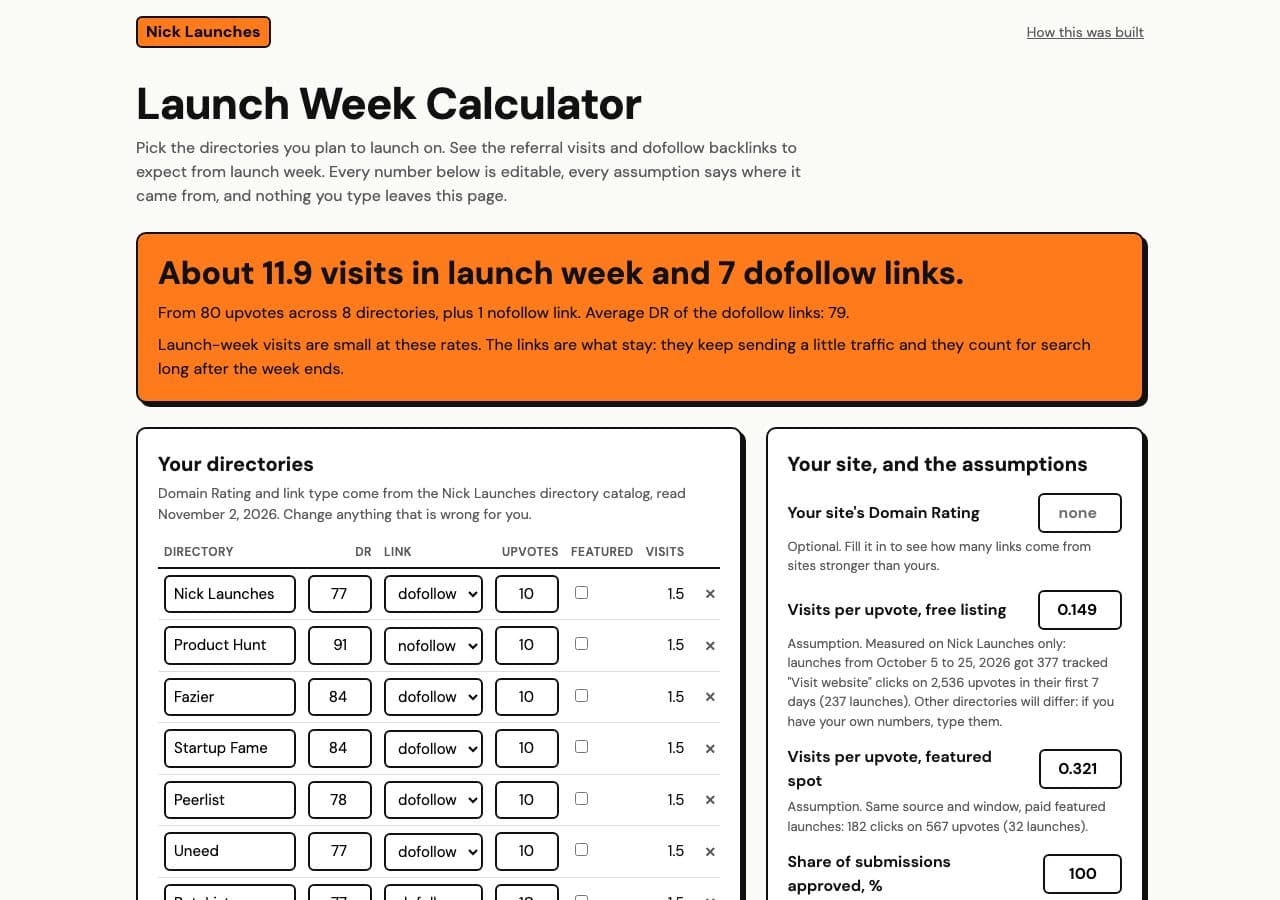
One HTML file can live anywhere. This site is a Next.js app, which serves files in public/ by their exact path only, so the folder URL needs one rewrite:
async rewrites() {
    return [
        { source: "/calculators/:name/", destination: "/calculators/:name/index.html" },
    ];
}A calculator that only answers questions about your own product is an ad with inputs. This one starts with eight launch boards, Nick Launches among them, and any of the 194 can be added or removed, so it is useful to someone who never launches here.
Try to break it
The worked examples from the spec are the tests. The page exposes its formula as one function, so a Playwright script fed it the three examples and compared the answers, then typed bad values into the page and watched what it did. Load time is on a local dev server.
| Check | Result |
|---|---|
| Worked example 1 (one row, free) | 1.49 visits, 1 link. Pass |
| Worked example 2 (three rows, one featured, your DR 50) | 7.68 visits, 2 links, 2 stronger. Pass |
| Worked example 3 (approval share 80%) | 2.384 visits, 1.6 links. Pass |
| Approval share typed as 140 | Field turns red, result asks you to check it. Pass |
| A directory that is not in the catalog | Added with DR 0 and a note to type its real DR. Pass |
| Network requests after typing | None besides the page and its fonts. Pass |
| Phone width, 390 px | Page scrolled sideways (464 px wide). Fixed, then 390 |
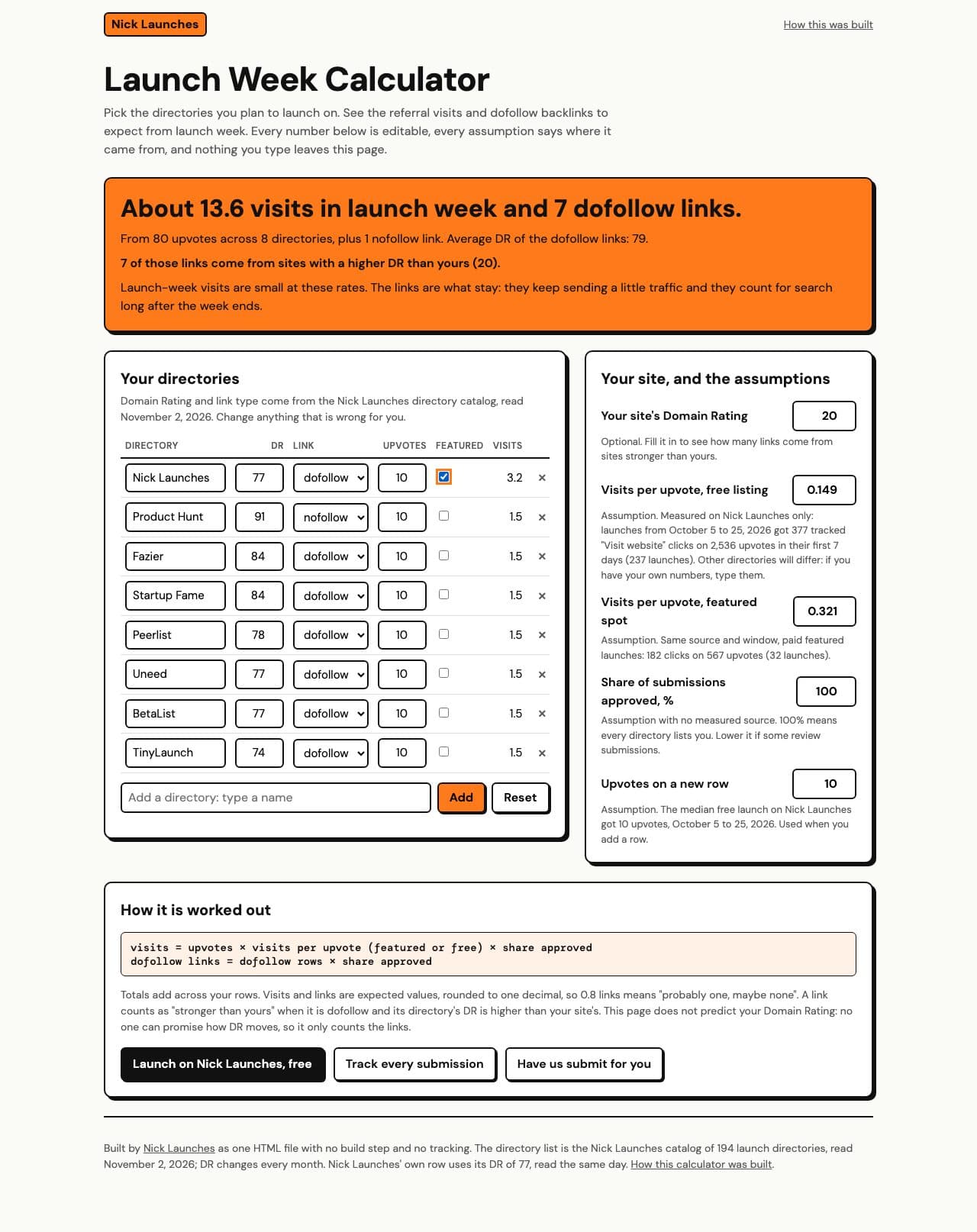
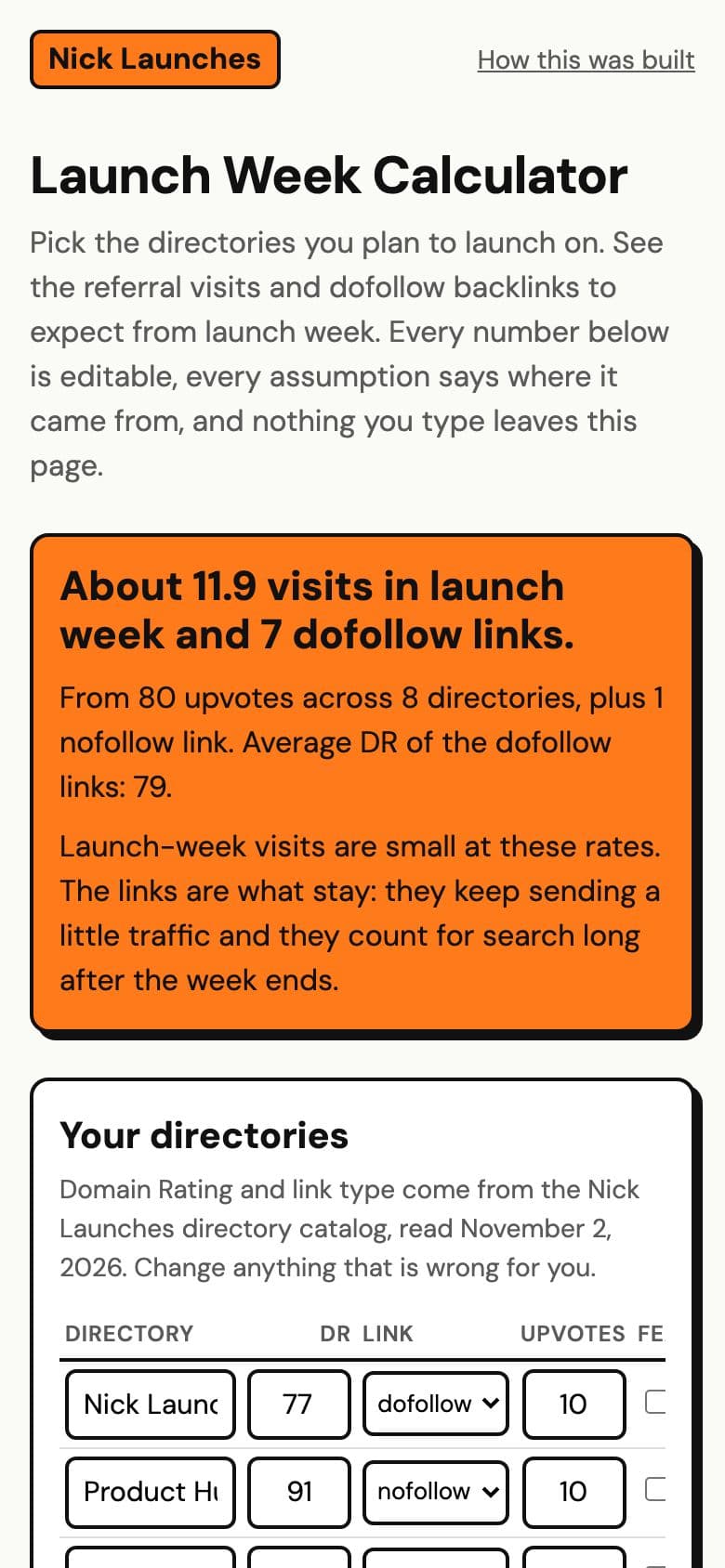
The one bug was layout, not math: on a 390 pixel phone the directory table pushed the whole page sideways. The table now scrolls inside its card and the page stays put at 320, 390 and 768 pixels.
Give the result a next step
In The AI Break's version, the result turns into a signup and a follow-up email: the visitor trades an email for the full breakdown. That is the right move when your offer needs a conversation.
I chose links instead. The calculator's promise is that nothing typed leaves the page, and a form sitting next to the numbers makes that harder to believe. Under the result there are three next steps: launch on Nick Launches for free, track every submission in the Launch Directories checklist, or have us submit for you. The default result also carries its own message: at these rates launch week brings a handful of visits, and the dofollow links are what last.
A number with nothing after it is a dead end. Whatever the result says, the next line should say what to do about it, and the button should do exactly that.
Send only the email the visitor typed into the form, never the numbers, and say so next to the button. Show the headline result before the form, not after it.
Launch the calculator like a product
A calculator is a product. Launch it the way you would launch one:
- List it on the boards. A free tool is a product with its own page and its own audience. Launching on Nick Launches is free and the listing link is permanent.
- Post the answer, not the tool. "Eight launch boards, 80 upvotes: about 12 visits and 7 dofollow links" is a post people argue with. The link goes underneath.
- Link it from where the question is asked. Your docs, your pricing page, the guide that explains the method. This guide is the calculator's "how it was built" page, and the calculator links back here.
- Keep the data dated. The catalog DRs say "read November 2, 2026". Refresh them when the catalog refreshes, and change the date when you do.
The whole thing, in order
- CLAUDE.md with the brief and the calculator rules (1)
- Five ideas scored, one picked for a reason you can say (2)
- Spec with ranges, sourced assumptions, three worked examples (3)
- One HTML file, defaults that need no typing (4)
- Worked examples as tests, bad input, phone width (5)
- A next step under every result (6)
- Listed as its own product on the boards (7)
- A post with one surprising result (7)
- Data dated, and a reminder to refresh it (7)
Try the finished one: the Launch Week Calculator. Then launch your own calculator on the weekly board.
FAQ
A calculator gives each visitor an answer about their own situation, so it gets used, bookmarked and shared, and it is the kind of page other sites link to as a resource. A PDF gets downloaded once. A calculator also shows your expertise in the formula, which is why every assumption has to be visible.
No. The rules, the picker and the spec are the hard part, and they work in any chat. Claude Code helps because the brief lives in a CLAUDE.md that every later step reads, and because it can write, run and fix the file in the same folder.
From your own data, with its source and date on the page, or from a published source you cite. If you have neither, leave the field for the visitor to fill and say so. The Launch Week Calculator's click rates come from Nick Launches' own listing pages, and its approval share says plainly that it has no measured source.
Show the headline result first. A gate before the answer turns a tool into a form, and people leave. The AI Break's version trades the email for a fuller breakdown after the result. Mine sends people to a next step instead, because the numbers never leave the browser.
It gives people a reason to link, nothing more. Launch it like a product, post the result it gives for a common case, and put it where people already look for tools. Links follow use.
Sources
- The AI Break, Tutorial: Build a Free Calculator That Brings You Leads With Claude Code, October 27, 2026 (paid post; the stages and rules are from its free preview)
- Click and upvote counts from Nick Launches' own listing pages, launches from October 5 to 25, 2026, first seven days of each launch, read November 2, 2026
- Domain Rating and link type from the Nick Launches directory catalog, read November 2, 2026
- Picker scores and spec from headless Claude Code runs on November 2, 2026 (62 s, 10 s and 109 s)
Disclaimer: Nick Launches is not affiliated with The AI Break or Anthropic. The click rates were measured on Nick Launches only and will differ on other directories.