How to Start an AI SaaS or AI Business in 2027: My Soft Launch, With Every Number
November 25, 2026
How to start an AI SaaS or AI business in 2027, from a real soft launch: 76 sign-ups, 8 Lifetime sales, $99.58 of Meta ads with no sign-ups, 1 Google click, and the 7 lessons behind them.
On November 8, 2026, the first person signed up for Prompt Generator (opens in a new tab). It writes prompts for the exact AI tool you use (ChatGPT, Claude, Gemini, Midjourney, Nano Banana, Veo) and runs image and video prompts on those models from one credit pool.
There was no Product Hunt day and no launch thread. A brand-new product with no user base rarely gets featured there, so Product Hunt waits until this one has a solid base of users. Instead I soft launched: put it live, reached out to the people who already use my other product, listed it in two directories, ran one small ad test and watched the numbers.
The numbers
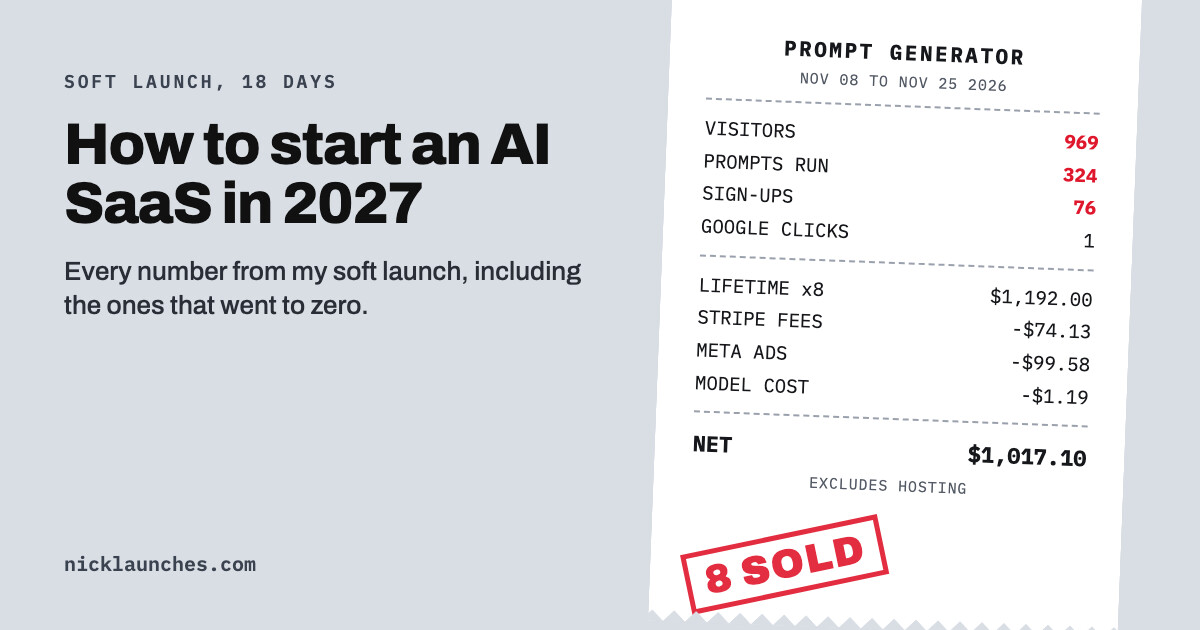
- 969 unique visitors, 1,419 sessions
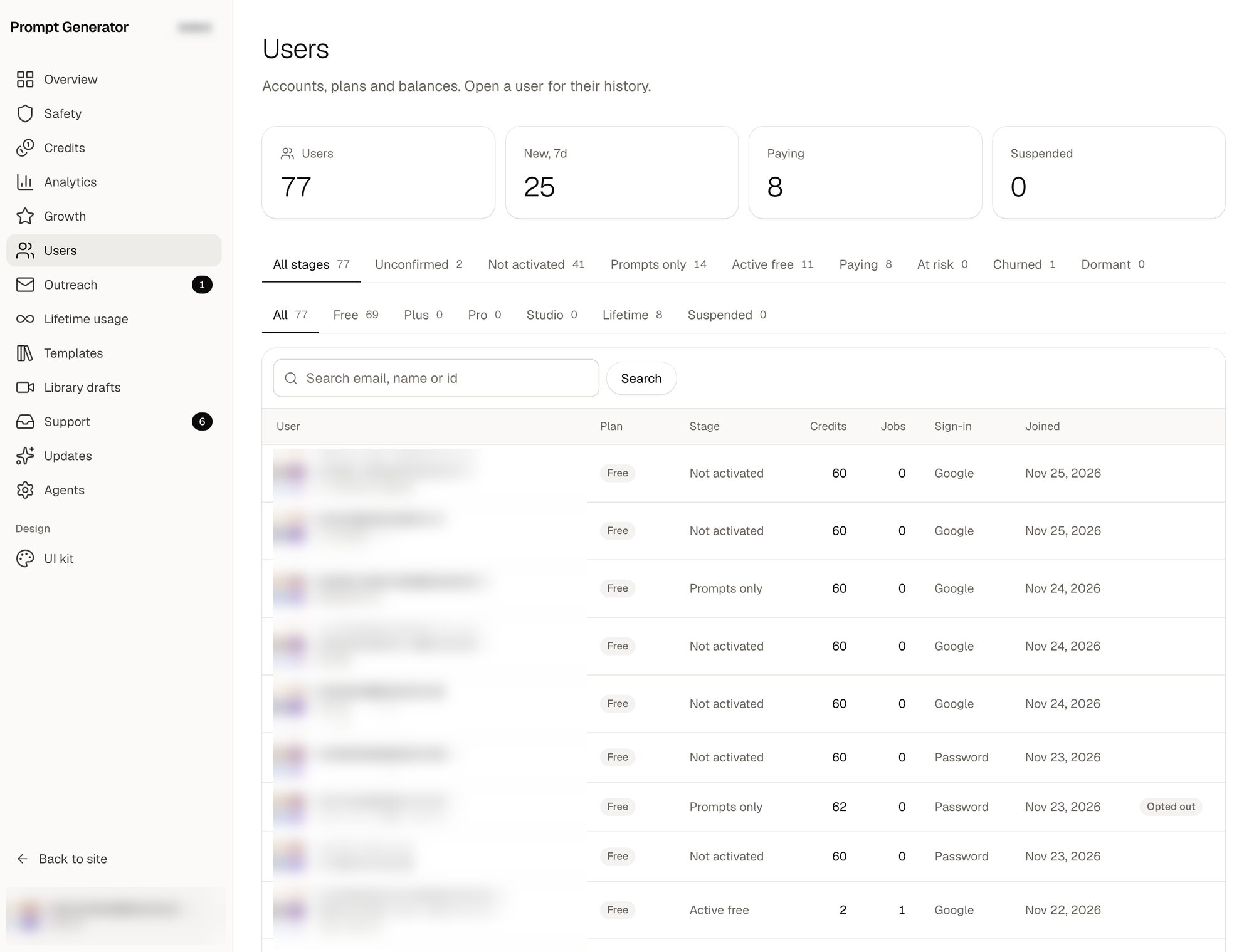
- 76 sign-ups
- 8 Lifetime sales at $149: $1,192 in revenue before Stripe fees, $1,117.87 after ($74.13 in fees)
- 0 monthly subscriptions
- 324 prompts written by the prompt tools, 123 of them copied
- 34 image and video generations by 13 people; total model cost $1.19
- 1 click from Google in 28 days
- $99.58 spent on Meta ads: 276 link clicks, 0 sign-ups, 0 sales
How I built it in a few weeks
I didn't start from zero. Prompt Generator is a fork of my own AI image and video studio codebase, so credits, Stripe, auth, moderation, storage and the model gateways already worked. What I built on top was the prompt tools, a prompt library and a new design.
Most of it shipped in one long day. On November 6 there were 37 commits: prompt generators, image to prompt, the library, plans and pricing, the new design system, the support inbox. There have been 119 commits since. It's one founder plus AI coding agents.
The stack, if you want to copy it: Next.js, Postgres with Prisma, Redis, Stripe, OpenRouter for text, image and video models, fal for a few image tools, Cloudflare R2 for files, Docker on a Hetzner server.
Lesson 1: If you've shipped one AI product, your second one should start as a fork. Billing, credits, refunds on failed generations and moderation take weeks to get right and are the same in every AI generation business. Build them once.
Where the sales came from
All 8 Lifetime sales came from outreach to existing Prompt Builder users. Prompt Builder is my other prompt product. I emailed them about Prompt Generator with an early Lifetime price, then sent one update. Seven sales carry the tracking link from those emails; the first came in before I'd added tracking.
Sign-ups by first touch:
- Prompt Builder: 31
- There's An AI For That (TAAFT): 16
- No recorded source: 29
- Nick Launches (nicklaunches.com), my launch directory: 1
- Google: 0
- Meta ads: 0
Sessions by source: direct 498, Meta ads 355, Prompt Builder 301, There's An AI For That 113, Nick Launches 21, Reddit 17.
Nick Launches is the launch directory I run. Its listing sent 21 sessions from 16 visitors; 4 of them ran a prompt and 2 signed up. Small numbers, but they're people who clicked through from a page about the product, not from an ad. If you're launching something, you can submit it there too: nicklaunches.com/submit (opens in a new tab).
Lesson 2: Your existing audience is your launch. A list of people who already trust you beats any channel you can buy in month one. If you don't have one, start building it before you write code.
The Meta ads test: $99.58, 0 sign-ups
I ran a small Meta campaign straight to a pay-first Lifetime page. $99.58 bought 7,181 impressions and 276 link clicks (about $0.36 a click) over 7 days. Not one of those people tried a prompt, signed up or bought.
Compare that with TAAFT: 93 visitors, 44 of them (47%) ran a prompt, and 16 signed up.
The difference wasn't the traffic, it was the page. Cold ad traffic landed on an offer for a product they'd never tried. Directory traffic landed on a tool they could use in 10 seconds without an account.
Lesson 3: Don't send cold traffic to a payment page. Send it to the free thing. A Lifetime deal works on people who already believe in you, and nobody believes in you after a 3-second ad.
The Lifetime deal paid for the launch
I priced Lifetime on a ladder: $149 for the first 100 buyers, $179 for the next 100, $209 for the next 100, then $249. Early Prompt Builder users kept $149.
It brought in $1,192 in 18 days with zero subscriptions next to it. Before selling it I added protections: Lifetime credits come as a monthly pool, a cheaper default model, fair use limits and bot checks. A Lifetime buyer who generates video every day can otherwise cost you more than they paid.
I've sold lifetime deals before, on AppSumo and other lifetime deal platforms. They bring volume, but the platform keeps a big share of every sale and the buyers are deal hunters, not your audience. Selling Lifetime yourself, from your own site with your own Stripe account, is by far the most profitable way to do it, as long as you can do the distribution yourself. Here the distribution was one email list, and the whole $149 per sale stayed with me, minus Stripe's fee.
Lesson 4: Lifetime deals are launch fuel, not a business model. Use them to fund the first months and find your first fans, sell them yourself if you have an audience, cap them with a price ladder, and make sure the heaviest user still can't lose you money.
AI is cheap; your time is the cost
34 image and video generations cost $1.19 at the gateway. The text prompt tools run on a fast, low-cost model and cost fractions of a cent each. Free users get 10 prompts a day without an account and 20 when signed in, and that free tier costs almost nothing.
Lesson 5: In an AI generation business, model costs aren't the risk early on, pricing is. Price every model from its real gateway cost, refund failed generations automatically, and the margin takes care of itself.
SEO: what a brand-new domain gets in month one
- 472 URLs in the sitemap, 832 published library prompts
- Domain Rating 6, 13 referring domains
- 1 click from Google in 28 days
Two things went wrong.
I left noindex on. The whole site carried a noindex header until November 10. Google crawled 38 of my 50 sampled pages on November 7 and 8, saw "do not index", and hasn't been back to most of them since. Two days of a forgotten setting can cost you weeks of crawl time on a new domain.
Pinterest blocks new domains. I made hundreds of pin images and bulk-imported them twice. Pinterest accepted the imports and silently dropped every pin: any link to the domain is flagged "may lead to spam". An appeal is pending.
What I'm doing instead: library pages go live 50 at a time every 3 days instead of all at once, the prompts are mirrored as an open dataset on Hugging Face and an awesome list on GitHub (571 prompts each) for links, and I write one comparison post a week for queries where people are choosing a paid tool.
Lesson 6: Check every robots header before launch day. And don't plan month one around Google. A new domain earns search traffic over months; month one runs on email, directories and communities.
What I got wrong about my users
My product notes said the main users would come from search, mostly on phones, mostly in India. Real sessions so far: US 547, Canada 222, UK 127, India 73. Desktop 774, mobile 566.
That's because nobody came from search yet. The people who came were my email list and directory browsers, and they're a different audience.
Lesson 7: Your first users tell you about your channels, not your market. Don't redesign for them until search traffic arrives and you can compare.
How to start an AI SaaS in 2027: the checklist I'd follow
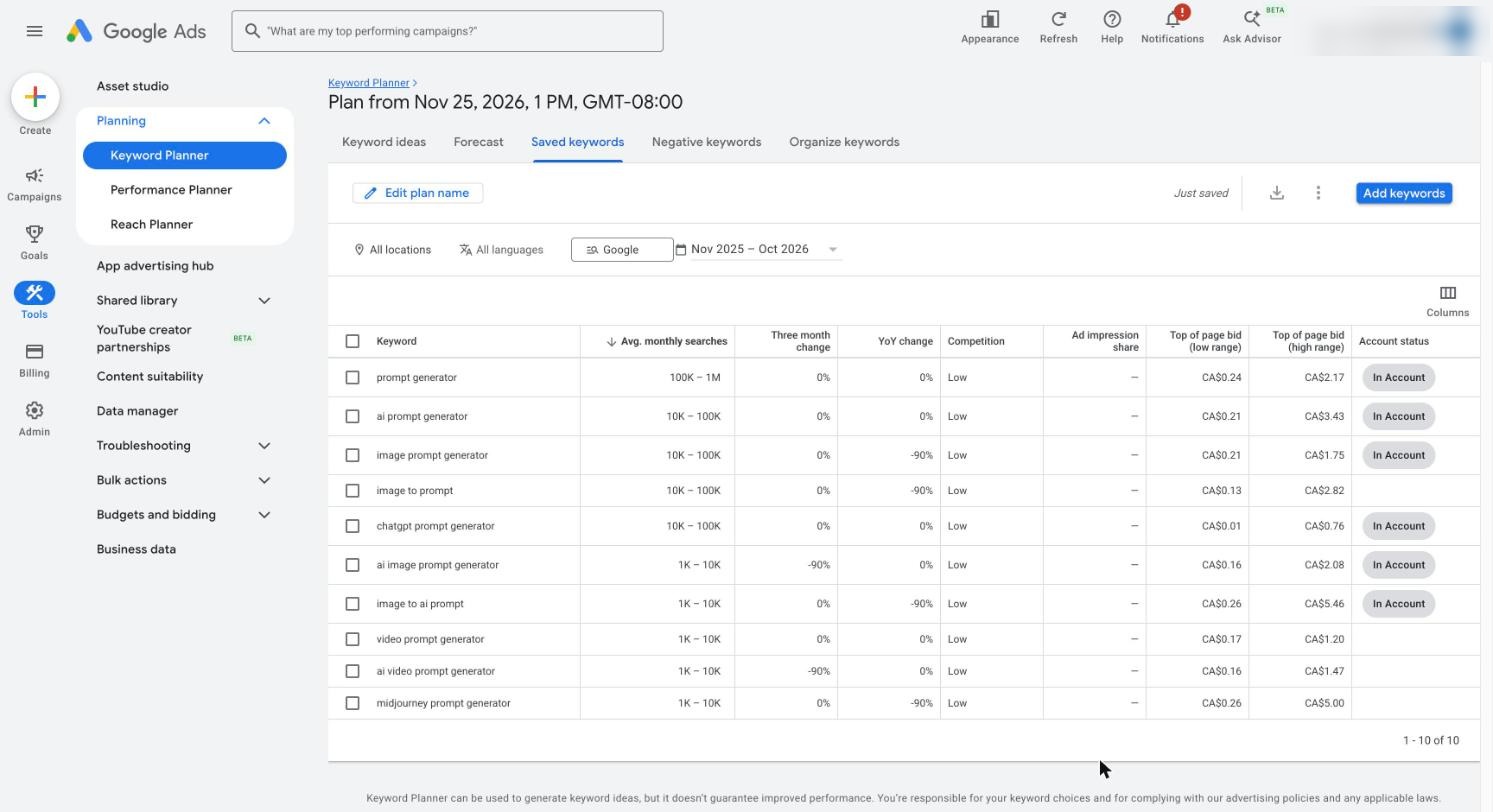
Google Ads Keyword Planner, all locations, November 2025 to October 2026.
- Pick a job people already search for. In Google Ads Keyword Planner, "prompt generator" gets 100K to 1M searches a month worldwide, and "AI prompt generator", "image prompt generator", "image to prompt" and "ChatGPT prompt generator" get 10K to 100K each. Check volume before you build.
- Start from code you've already shipped, or a boilerplate with billing, credits and refunds done.
- Make the free version useful without an account. Anyone landing should get a result within a minute.
- Route every model through a gateway (OpenRouter or similar) so you can switch models when prices change.
- Put attribution in from day one. First touch on every account, source on every payment. I can tell you where all 8 sales came from because of it.
- Soft launch to your own audience first, then a couple of directories (I used There's An AI For That and Nick Launches), then everything else. Save Product Hunt for when you have users.
- Sell a capped Lifetime deal yourself to the people who already trust you, with usage limits that protect you. Use AppSumo-style platforms only if you can't reach buyers on your own.
- Test paid ads small, and only point them at the free tool.
- Release SEO pages in batches, check noindex twice, and treat Google as a month three channel.
- Publish your numbers. This post is part of my distribution.
What's next
- A Chrome extension and iOS and Android apps are built; store submission is next.
- First monthly subscriber (the real test of the business).
- First Google traffic once the recrawl happens.
I'll post the next update with the same numbers, good or bad.
Launching your own product? Submit it on Nick Launches: nicklaunches.com/submit (opens in a new tab)