145 GitHub Stars, Two Accounts: From CTO to Solo Founder
September 26, 2026
Seven years leading teams: 21,000 commits, one star. One year solo: 116 stars. What changed, and the 20 repos that made it into my daily stack.
I went through every repo I've ever starred on GitHub.
Turns out that's two accounts.  smxdevst (opens in a new tab), the one I used from my first frontend job all the way to CTO, and
  nicklaunches (opens in a new tab), the one I build on now.
145 stars in total, going back to 2015.
I expected a messy bookmark folder. What I got was a pretty honest timeline of my career, and of how building software changed.
The Numbers
| Period | Stars | Contributions |
|---|---|---|
| 2015-2017 | 23 | 3,831 |
| 2018-2024 | 1 | 20,971, almost all private |
| 2025 | 23 | 2,148 |
| 2026 (to September) | 98 | 4,368 |
Read that second row again.
Seven years, nearly 21,000 contributions, one star.
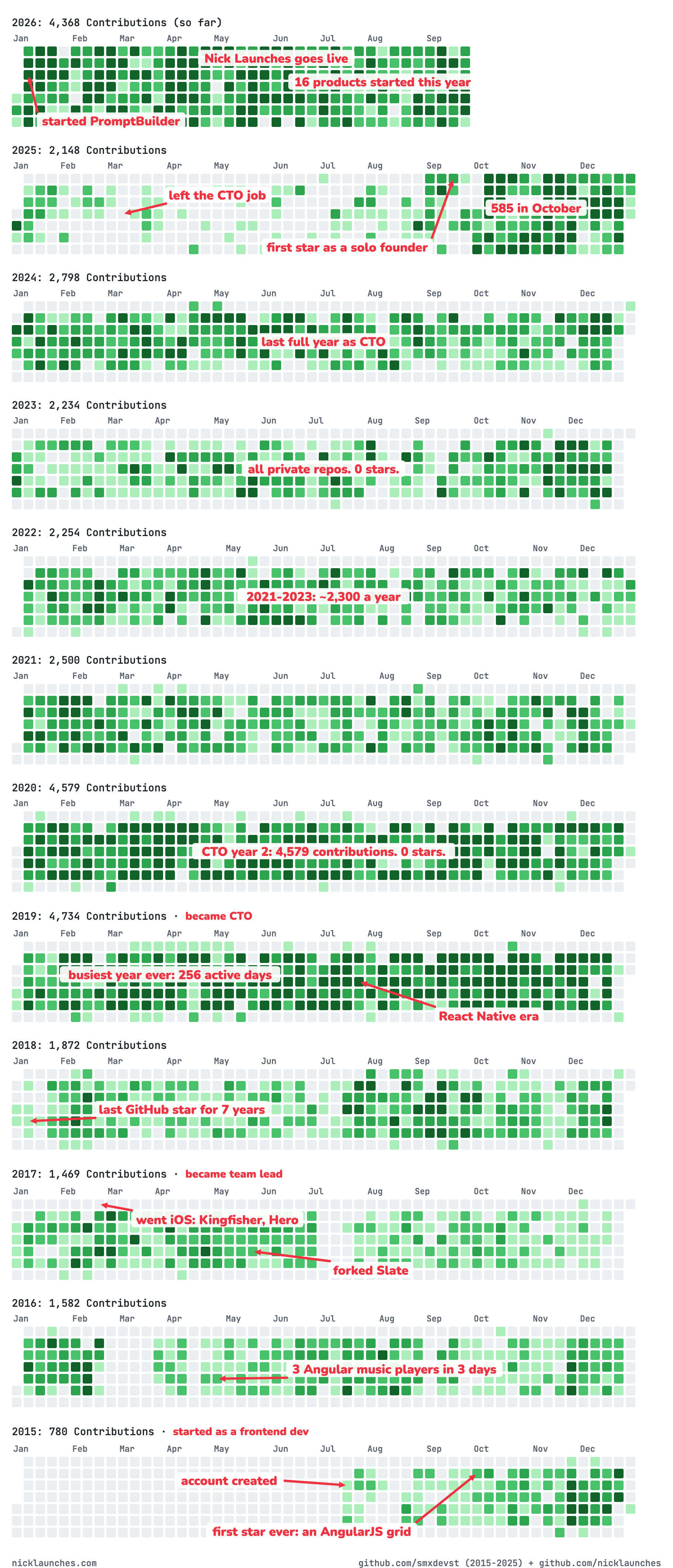
Both accounts, merged into one graph per year. Almost everything from 2018 to 2024 is in private repos.
2015-2017: The Angular and Swift Years
I started in 2015 as a frontend developer.
My first star ever was  ngFlowGrid (opens in a new tab), September 2015. An AngularJS grid directive. Two days later,
  angular-photoswipe (opens in a new tab).
That's what the early stars look like. Small, specific, solving one problem that week:
- AngularJS bits:
 angular-google-places-autocomplete (opens in a new tab),
  angular-dialog-service (opens in a new tab),
  angular-svg-round-progressbar (opens in a new tab), three different Angular audio players (
 ngAudio (opens in a new tab),
  angular-soundmanager2 (opens in a new tab),
  solarizd (opens in a new tab))
 - Backend:
 mysqljs (opens in a new tab)
 - UI:
 iziToast (opens in a new tab),
  css-protips (opens in a new tab)
 - iOS, early 2017:
 Kingfisher (opens in a new tab),
  Hero (opens in a new tab),
  Toaster (opens in a new tab),
  AnimatedCollectionViewLayout (opens in a new tab),
  BTNavigationDropdownMenu (opens in a new tab)
 - Learning:
 freeCodeCamp (opens in a new tab),
  You Don't Know JS (opens in a new tab),
  ios-good-practices (opens in a new tab),
  design-patterns-for-humans (opens in a new tab)
Every one of these is a library you import. A toast. An image cache. A dropdown. A dialog.
The job was assembling UI from parts, and GitHub was the parts store.
Team Lead, Then CTO: Almost No Stars
In 2017 I became a team lead, and the stars change.  awesome-design-systems (opens in a new tab). mail-for-good (opens in a new tab). A fork of
  Slate (opens in a new tab) for a rich text editor. Less "I need a dropdown," more "how should this whole system work."
Then in January 2018 I starred  an ngrx demo (opens in a new tab) for sharing state between Ionic and Angular apps.
That was the last star for seven years.
In 2019 I became CTO. The stars stayed at zero, but the building never slowed down:
| Year | Role | Contributions |
|---|---|---|
| 2018 | Team lead | 1,866 |
| 2019 | CTO | 4,693 |
| 2020 | CTO | 4,573 |
| 2021-2024 | CTO | 9,778 |
Almost all of it in private repos. My first year as CTO was my busiest year ever, with 256 active days. The only public trace is a couple of React Native forks ( Rocket.Chat (opens in a new tab),
  react-native-webview (opens in a new tab)) from 2019.
That's the thing about being a CTO. You're shipping every day, but none of it is visible, and you stop browsing for new tools because the stack is already decided. Your job is making it work.
The Handoff
The two accounts pass the baton almost exactly.
Old account, 2025: 129 contributions in January, 31 in February, 3 in March. Then basically nothing.
New account, 2025: 21 contributions in March. Then 34 in June, 76 in August, 148 in September, 585 in October, 622 in November.
I left in 2025, and the graph shows it better than I could write it.
Coming Back to a Different Stack
My first star on the new account was a  .claude config repo (opens in a new tab), September 2025.
Not a library. A folder of instructions for an AI agent.
October 15, 2025 tells the story even better. On a single day I starred  shadcn/ui (opens in a new tab),
  Tailwind (opens in a new tab),
  Zustand (opens in a new tab),
  spec-kit (opens in a new tab) and
  HyperAgent (opens in a new tab).
Three of those are the modern React stack I was catching up on. The other two are "how do you get an AI to build with it."
Three days later: the official  MCP servers (opens in a new tab) and GitHub's MCP server (opens in a new tab).
I wasn't coming back to the same job. I was coming back as a solo founder where the "team" is a set of agents.
The Stack I Actually Run
Most stars are bookmarks. These ones turned into things I use every week.
Agents
 OpenBot (opens in a new tab): AI coworkers that each get their own computer. I forked it, run it on my own server, and have sent a few PRs upstream. This one went from star to fork to contributor in weeks.
 Hermes Agent (opens in a new tab): I run several Hermes profiles as coworkers that talk to each other and to me over Telegram.
 codex-plugin-cc (opens in a new tab): Use Codex from inside Claude Code for a second opinion or a stuck bug. Two models reviewing each other catch more than one.
 Cua (opens in a new tab): computer-use drivers for when an agent needs to click through a native Mac app.
 CodexBar (opens in a new tab): usage stats for Codex and Claude Code in the menu bar. Small, but I check it daily.
Browsers and Scraping
 Lightpanda (opens in a new tab): a headless browser built for AI and automation. It replaced Chrome as my default for fetching and scraping. Chrome now only comes out for screenshots, logged-in sessions and Google.
 Crawlee (opens in a new tab) and
  Scrapegraph-ai (opens in a new tab): the reliable crawler and the LLM-driven one. Different jobs.
 LibreCrawl (opens in a new tab): an open source Screaming Frog alternative. Starred it last week, still kicking the tires.
Design and UI
 impeccable (opens in a new tab): a design language for AI coding agents. The biggest single upgrade to what my agents ship visually.
- shadcn/ui (opens in a new tab),
 ReUI (opens in a new tab), Tailwind (opens in a new tab): the base layer under almost everything I build now.
  awesome-design-md (opens in a new tab): DESIGN.md files extracted from known brands. Drop one in the repo and the agent stops inventing its own style.
SEO and Growth
 mcp-gsc (opens in a new tab): Google Search Console inside Claude. Weekly SEO checks across my sites run on this kind of setup.
 claude-seo (opens in a new tab) and
  marketingskills (opens in a new tab): skill packs for technical SEO, CRO and copy.
 notebooklm-mcp (opens in a new tab): pipes research into NotebookLM so I can query a pile of sources instead of rereading them.
 watermarks-remover (opens in a new tab): strips hidden characters and metadata from content before it goes out. Runs locally in Docker.
Things That Rhymed
Putting both accounts side by side, some stars are nine years apart and basically the same idea:
- 2017: awesome-design-systems (opens in a new tab), design systems for humans to read. 2026: awesome-design-md (opens in a new tab), design systems for agents to read.
- 2017: forked Slate (opens in a new tab) for a rich text editor. 2025: starred
 Tiptap (opens in a new tab) and
  Novel (opens in a new tab). Same problem, now with AI autocomplete.
 - 2017: design-patterns-for-humans (opens in a new tab). 2026:
 Karpathy's CLAUDE.md (opens in a new tab). Both are "here's how to write good code," for a different reader.
 - 2019: React Native forks. 2026: an Expo app. Mobile came back too.
The problems don't change much. Who does the typing does.
The Skills Gold Rush
January 2026 was 13 stars. Most of them were Claude skills collections:  anthropics/skills (opens in a new tab), three different
  awesome-claude-skills (opens in a new tab) lists,
  claude-skills (opens in a new tab),
  Skill Seekers (opens in a new tab) and
  wshobson/agents (opens in a new tab).
Over the next months came  stop-slop (opens in a new tab),
  agency-agents (opens in a new tab) and
  Matt Pocock's skills (opens in a new tab).
Even the old account got pulled back in. In April 2026, after seven silent years, it starred  claude-mem (opens in a new tab),
  ECC (opens in a new tab),
  Agent Zero (opens in a new tab),
  GEPA (opens in a new tab) and awesome-agent-skills (opens in a new tab) within ten days.
Some of these repos have 150K to 270K stars. The whole industry was doing the same thing I was: collecting prompts in folders.
Honest take: the lists were useful for about a week. You skim them, steal two or three ideas, and write your own skills for your own workflows. The skills that stuck in my setup are the ones I wrote for a specific job, not the ones I installed in bulk.
The Directory Lists
There's one more cluster, and it's the one closest to what I do now.
On October 25, 2025 I starred nine AI lists in one day:  ai-directories (opens in a new tab),
  awesome-ai-directories (opens in a new tab),
  awesome-ai-tools (opens in a new tab),
  awesome-generative-ai (opens in a new tab) and a few more.
That was me researching where a product can get listed and found. Since then:  Product Hunt alternatives (opens in a new tab), AI agents directories (opens in a new tab),
  startup launch platforms (opens in a new tab),
  free AI directories with DA scores (opens in a new tab).
If you're about to launch something, these lists are a decent map. Check which ones are still maintained before you spend an afternoon on them.
What 145 Stars Taught Me
I starred the least when I built the most. My first two years as CTO were over 9,000 contributions and zero stars. Six CTO years, 19,000 contributions, not one star. Stars measure curiosity, not output. When the stack is decided, you stop shopping.
In 2016 I starred things to import. In 2026 I star things for agents to run. A toast library became a skill file. An image cache became a headless browser my agents drive. A dropdown menu became a DESIGN.md.
Stars on lists are bookmarks. Stars on tools are commitments. Out of 116 stars on the new account, maybe 20 are in my daily setup. That ratio feels right.
Solo with agents keeps pace with a whole CTO year. As of late September, the new account has 4,364 contributions in 2026. My busiest year as a CTO was 4,693. There's still a quarter left.
What's the oldest repo in your GitHub stars? Curious what it says about where you started 👀